

VoD and OTT Streaming CDN
Pre-encoded HLS and DASH delivered from the edge, with an LL-HLS path in the 2-4 second range where standard HLS leaves viewers 20-40 seconds behind the action.
From $5/TB down to $2.50/TB, so 100 TB of streaming is about $415 a month · 14-day testing period on real traffic · $25 monthly minimum waived · Engineer reply within 3 business hours





What 100 TB of streaming costs
First 5 TB
- $25 for the whole tier
- This is also the monthly minimum
5 to 25 TB
- $90 for the next 20 TB
- 25 TB in total: about $115
25 to 100 TB
- $300 for the next 75 TB
- 100 TB in total: about $415
Your catalogue, played from the edge

 Served from
Every title, every rendition
Cached once per region
Try it in your own player
https://cdn84906683.blazingcdn.net/car-movie/hls/master.m3u8 · Segments: 4 s · Footage: Pixabay, free licence How chunks reach the player

What the stream runs on
Formats we deliver
- HLS and M3U8 playlists
- LL-HLS with partial segments
- DASH, adaptive bitrate
- HDS, where your estate still needs it
- MSS, Microsoft Smooth Streaming
Protecting the stream
- Signed URLs with an expiry
- Hotlink protection
- IP whitelisting and geofencing
- DRM-encrypted segments, keys stay yours
- HTTPS enforced on every zone
Players and devices
- Web players with LL-HLS support
- iOS and Android
- Apple TV, Roku, Android TV
- Your own hostname and SSL certificate
- CORS configured per zone
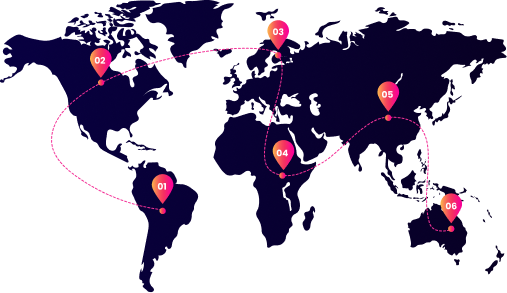
Network Carriers
- North America
- NTT
- AT&T
- Lumen (Level 3)
- Cogent
- Comcast
- Europe
- NTT
- Deutsche Telekom
- Orange
- Lumen (Level 3)
- Liberty Global
- Sparkle
- Cogent
- Telefonica
- Telia
- Zayo
- Asia-Pacific
- NTT
- Lumen (Level 3)
- KINX
- PLDT
- Singtel
- SK Broadband
- Tata Communications
- Telstra
- South America
- NTT
- Lumen (Level 3)
- Lanautilus
- Telefonica
Simple setup: just bring your media server
To get started with BlazingCDN’s Streaming CDN, all you need is your own media server. We are a delivery layer, not a processing layer: we do not transcode, re-package or generate manifests, and that is exactly why nothing we do can break your encoding pipeline.
- Supported media servers: Wowza Streaming Engine, NGINX RTMP, FFmpeg and others that produce HLS or DASH output.
- Flexible configuration: point the zone at your packager’s output and put the CDN hostname in your player config. Test on a temporary hostname before switching DNS.

					{
  "pull_zone": {
    "name": "string",
    "source": "origin",
    "origin": "string",
    "origin_ssl": true,
    "origin_url": "string",
    "bucket_id": "8f7ac8aa-ed2b-4e16-81e0-0766bdb092b8",
    "folder_name": "string",
    "cache_gzipped": true,
    "domain": "string"
  }
}
Media Streams with Full API Support
BlazingCDN’s Streaming CDN includes an extensive API that gives you full control over your CDN configuration, allowing for automation, monitoring, and customization of your streaming delivery.
Test CDN Speed Across Top Regions
Avg. Download Speed
Latency
Test link
Streaming teams, written up in full
OTT provider, multi-region
Live sports streaming
Short-video platform
E-learning platform
Move without a risky migration
Run a 14-day testing period
Keep your current CDN running
Start with one region or one channel
An engineer, not a ticket queue
Which product carries your stream

Anycast CDN

Video CDN

HLS Streaming CDN
Files on Demand
Questions buyers ask about OTT and VOD streaming delivery
BlazingCDN delivers pre-encoded HLS, LL-HLS and DASH streams for OTT and VOD platforms, either as a replacement for the current CDN or as a second CDN next to it. Segments are cached once per region and served from the edge. Pricing runs from $5 to $2.50 per TB, so 100 TB of streaming costs $415 a month.
How much does an OTT platform pay to stream 100 TB monthly?
An OTT platform pays BlazingCDN $415 to stream 100 TB in a month (as of October 2026). The first 5 TB bill at $5 per TB, the next 20 TB at $4.50, and the remaining 75 TB at $4.00. The same rate covers viewers in the US, Europe and Asia.
Streaming bills grow fast, so the tiers keep stepping down. For example, 200 TB costs $765 and 500 TB costs $1,815 a month. At 1,000 TB the total is $3,315. BlazingCDN adds no request fees, which matters for HLS: every few seconds each player requests a new segment and a refreshed playlist. No setup fee and no long-term contract apply. Enterprise terms start from 100 TB a month, and a quote never raises the published price. The 14-day testing period runs on real viewers, with the $25 monthly minimum waived.
How do HLS and DASH segments reach viewers through BlazingCDN?
BlazingCDN pulls HLS and DASH segments from your packager once per region, caches them on NVMe SSD edge servers, and serves every later viewer from the edge. Across the network, the average cache hit ratio is 96%+.
Playlists and segments get different cache rules. Manifests change constantly, so they use short TTLs. Segments never change after encoding, so they use long TTLs and stay cached for every rendition in the bitrate ladder. Supported formats include HLS with M3U8 playlists, LL-HLS with partial segments, DASH with adaptive bitrate, HDS and Microsoft Smooth Streaming. LL-HLS keeps viewers in the 2 to 4 second range, where standard HLS often runs 20 to 40 seconds behind. Web players, iOS, Android, Apple TV, Roku and Android TV all work with your own hostname and certificate. For example, a new episode released at 8 pm is fetched from origin once per region, then served from cache.
Does BlazingCDN transcode or package video for OTT?
No, BlazingCDN does not transcode, re-package or generate manifests. The service is a delivery layer for streams you have already encoded, so nothing on the CDN side can break your renditions.
You bring a media server that produces HLS or DASH output. Wowza Streaming Engine, NGINX RTMP and FFmpeg all work, as do other packagers with standard output. Encryption also stays with you: DRM-encrypted segments pass through the CDN while the keys remain yours. BlazingCDN is a good fit for platforms that already run an encoding workflow and want steadier, lower-cost delivery. A team without an encoder needs a separate transcoding service first. For example, a broadcaster can keep its FFmpeg ladder at 1080p, 720p and 480p and point a BlazingCDN zone at the packager output. Delivery then costs from $5 per TB down to $2.50 per TB (as of October 2026), with no request fees.
Can we add BlazingCDN alongside our current video CDN?
Yes, BlazingCDN can run next to your current video CDN behind DNS with a weighted traffic split, so a migration never has to be all or nothing. Many OTT teams start with one region or one channel.
The usual path takes a few steps. Onboarding with an engineer takes about one hour. Point a zone at your packager output and test on a temporary hostname in your own player. Then send a share of viewers to BlazingCDN, for example 10% of European traffic, and compare startup time, rebuffering and cost against the incumbent. The 14-day testing period runs on real production traffic, with the $25 monthly minimum waived (as of October 2026). A KYC check is required before production traffic. Your current CDN stays live the whole time, and the DNS weight can be moved back at any point. An engineer replies within 3 business hours, so problems go to a person, not a ticket queue.
How does BlazingCDN protect OTT streams from unauthorized playback?
BlazingCDN protects OTT streams with expiring signed URLs, hotlink protection, IP whitelisting, geofencing and enforced HTTPS on every zone. DRM-encrypted segments are delivered as is, and the decryption keys stay with you.
Signed URLs are the main control. Each playlist or segment link carries a signature and an expiry time, so a copied link stops working after the window closes. For example, a 3-hour signature covers a feature film plus a pause, and then the URL no longer plays. Geofencing limits playback to the countries in your license, and IP whitelisting restricts an origin or a partner feed to known addresses. Hotlink protection blocks other sites from embedding your stream. CORS is configured per zone, and each zone can use your own hostname and SSL certificate. Signed URLs, geofencing and hotlink protection are included in the per-TB price, from $5 per TB down to $2.50 per TB (as of October 2026).