

CDN for Software Companies
Installers, patches and game builds, served from the edge on release day instead of from your build server.
From $5/TB down to $2.50/TB, so 100 TB of downloads is about $415 a month · 14-day testing period on real traffic · $25 monthly minimum waived · Engineer reply within 3 business hours





Results from teams on BlazingCDN
Three delivery cases from our knowledge base, with the full write-ups one click away.
98%+ cache hit within 90 minutes of a major release
2 GB installers served from nearby edge nodes worldwide, with resumable downloads and origin load staying flat during peak download windows.
Under 3% of patch-day requests reach the origin
A 15 GB patch requested at the same time in Tokyo, Los Angeles, Frankfurt and São Paulo, with cache hit above 97% in the first hour.
97%+ segment cache hit for VOD
Short TTLs for manifests, long TTLs for segments, and steady segment delivery across every bitrate tier in the ABR ladder.
What 100 TB of downloads costs
First 5 TB
- $25 for the whole tier
- This is also the monthly minimum
5 to 25 TB
- $90 for the next 20 TB
- 25 TB in total: about $115
25 to 100 TB
- $300 for the next 75 TB
- 100 TB in total: about $415
Four ways software gets shipped
SaaS platforms with 24/7 patch delivery
Game launchers and versioning
DevOps CI/CD and nightly builds
Installer vendors and app catalogues
Which product carries your builds

Anycast CDN
Cloud Storage for CDN
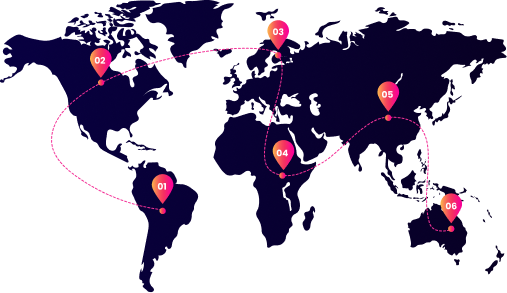
Files on Demand
What happens the hour a release goes live
Ten thousand people pull a cold file
The download is 4 GB and the line drops
You want the cache warm before launch
A patch ships the wrong binary
Test CDN Speed Across Top Regions
Avg. Download Speed
Latency
Test link
Keeping paid builds paid
Signed links
- HMAC signature with an expiry
- URL bound to one IP
- Limit on IPs per URL
Request filters
- Referrer and user-agent checks
- Cookie checks, standard and extended
- Geo allow and block lists
Transport and indexing
- HTTPS enforced, insecure requests refused
- Secrets managed per resource
- Googlebot bypass for public pages
					{
  "pull_zone": {
    "name": "string",
    "source": "origin",
    "origin": "string",
    "origin_ssl": true,
    "origin_url": "string",
    "bucket_id": "8f7ac8aa-ed2b-4e16-81e0-0766bdb092b8",
    "folder_name": "string",
    "cache_gzipped": true,
    "domain": "string"
  }
}
24/7 DevOps Escalation
BlazingCDN plugs into the stack you already run: a REST API for zones, cache, certificates and metrics, an official MCP server for AI agents, and a Prometheus endpoint for Grafana or Alertmanager.
Purge and warm up cache from your CI, pull traffic data into your own dashboards, and keep the panel for the rare manual change.
Where to go next
Questions buyers ask about a CDN for software delivery
BlazingCDN delivers installers, patches, game builds and nightly binaries from the edge instead of from a build server. Single files up to 50 GB are supported, requests are never billed, and pricing runs from $5 to $2.50 per TB (as of October 2026). For example, 100 TB of downloads costs $415 a month.
How much does a CDN cost for 200 TB of software downloads?
BlazingCDN bills 200 TB of software downloads at $765 a month (as of October 2026), across progressive tiers. The first 100 TB cost $415. The next 100 TB fall in the 100 to 500 TB tier at $3.50 per TB, which brings the month to $765. Download requests are never billed, so an updater that checks for new versions millions of times a day adds nothing beyond the bytes delivered.
For example, a 2 GB installer pulled 100,000 times is 200 TB. A download in Seoul costs the same as one in Frankfurt, because BlazingCDN applies no regional multiplier and no setup fee. At that volume enterprise terms are available, since they start from 100 TB a month, and a quote never raises the published price. Billing is pay as you go or monthly, with no long-term contract. Raw logs for download analytics cost $50 per month, while real-time statistics and Prometheus metrics are included.
How does a CDN handle release day for a new installer?
BlazingCDN absorbs a release by collapsing concurrent cache misses for the same file into a single origin fetch, so ten thousand users pulling a cold installer trigger one request to the build server. Origin shield adds a second layer between the edge and the origin. Across the network, the average cache hit ratio is 96%+.
Teams can warm the cache before launch through the REST API, so the first users already hit cached copies. If a patch ships the wrong binary, a purge by path removes it, and the CI pipeline can trigger that purge automatically. Interrupted downloads resume, which matters for a 4 GB build on a weak line. Delivery speed can also be capped per account, domain or URL. For example, a 15 GB patch can go out over several hours instead of one spike, which keeps peak bandwidth predictable without blocking anyone.
Is BlazingCDN a good fit for game patches over 20 GB?
BlazingCDN supports single files up to 50 GB, so a 20 GB or 40 GB game patch is delivered as one object without splitting. Files above 50 GB need to be split into parts or chunked by the launcher. A 50 GB installer bills on the same per TB tiers as a 20 KB icon, starting at $5 per TB and falling to $2.50 per TB (as of October 2026).
Game launchers usually request many chunk files at once, and BlazingCDN never bills requests, so chunked patch formats cost only their bytes. The network runs on NVMe SSD servers, which keeps large-file reads from becoming a disk bottleneck. Measured June 2026 on a 100 MB HTTPS download, throughput reached 1.12 Gb/s in Europe, 1.11 Gb/s in North America and 761 Mb/s in Asia. Patch diffing and version logic stay in the launcher, and BlazingCDN delivers the files the launcher requests.
How do I move software downloads to BlazingCDN without downtime?
BlazingCDN onboarding for a download domain takes about one hour with an engineer, and the current CDN keeps serving while the new zone is tested. The engineer creates a pull zone pointed at the existing origin or at Cloud Storage, then issues a temporary hostname for checks. Real installers can be fetched and hashed before any DNS change.
Next, BlazingCDN joins as a second CDN behind DNS with a weighted traffic split. For example, 20% of downloads can move first, or only the patch path for one game. The 14-day testing period runs on that real production traffic, after a KYC check. If numbers look wrong, the weight goes back to zero. Builds stored at the origin never move, so no file migration needs scheduling. For teams that store builds with BlazingCDN instead, Cloud Storage costs $0.015 per GB per month (as of October 2026).
How can I protect paid software builds from link sharing?
BlazingCDN protects paid builds with HMAC signed URLs that carry an expiry, and each signature can be bound to one client IP or to a limit on IPs per URL. A leaked download link therefore stops working once the expiry passes. For example, a license portal can issue a link valid for 24 hours and tied to the buyer’s address.
Request filters add more control at no extra cost: referrer and user-agent checks, standard and extended cookie checks, and geo allow and block lists. HTTPS can be enforced so insecure requests are refused, and TLS 1.3 is supported. Secrets are managed per resource, so a game and a SaaS client can rotate keys independently. All of these features ship on every plan, with no security tier to buy. BlazingCDN does not sell license key management, so activation and entitlement checks stay in the vendor’s own system.