
EDUCATION · LECTURES AND LIVE CLASSES
CDN for Online Education
Lecture recordings, live classes and course files, delivered from the edge when a whole cohort presses play in the same minute.
From $5/TB down to $2.50/TB, so 100 TB of course delivery is about $415 a month · 14-day testing period on real traffic · $25 monthly minimum waived · Engineer reply within 3 business hours
97%+
VOD segment cache hit
2-4 s
Latency on LL-HLS live
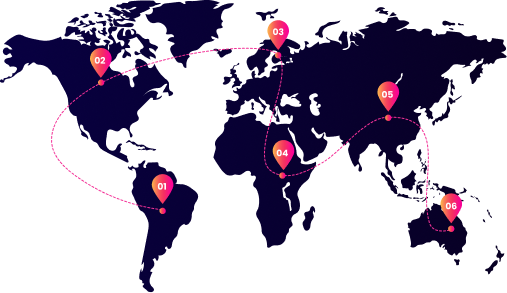
3 regions
One rate in Europe, Asia and America





What 100 TB of course delivery costs
Progressive tiers work like tax brackets: each rate applies only to the traffic inside its range. Requests, HTTPS, custom domains and origin shield are included, and the rate is the same in Europe, Asia and America.
TIER 01
First 5 TB
$5.00 per TB
- $25 for the whole tier
- This is also the monthly minimum
TIER 02
5 to 25 TB
$4.50 per TB
- $90 for the next 20 TB
- 25 TB in total: about $115
TIER 03
25 to 100 TB
$4.00 per TB
- $300 for the next 75 TB
- 100 TB in total: about $415
100 TB a month works out at $415
Each tier is billed only on the traffic inside it, so the tiers add up rather than replace each other. 25 TB is about $115, 500 TB is about $1,815, and above 500 TB a month we quote it for you.
Lessons stream from the closest node
A talking-head lesson packaged as HLS, six renditions from 360p to 4K. Students on slow connections get 360p without buffering, fast ones get 4K, and the origin is never asked twice.
HLS · Anycast pull zone
1080pQuality·Bitrate·Last segment Served from
Served fromSix renditions, one manifest
360p to 4K in one HLS ladder. The player starts on Auto and switches as bandwidth changes; pick a fixed quality from the settings icon.
Cached once per region
The first viewer pulls a segment from Cloud Storage; every next viewer in that region gets it from the edge, and your origin stays idle.
Try it in your own player
Copy the manifest URL below into VLC, Safari or any HLS player. Same files, same CDN, no sign-up.
Manifest:
https://cdn84906683.blazingcdn.net/bloger-streaming/hls/master.m3u8 · Segments: 4 s · Footage: Pexels, free licence Four things a teaching schedule does to a CDN
A course platform is not a video site. The load arrives on a timetable, and most of what you deliver is not video at all.
A lecture starts at nine, for everyone
Scheduled sessions are the opposite of a long tail: the whole cohort arrives inside the same minute. Concurrent misses collapse into one origin fetch, so your platform answers once and the edge serves the rest.
Paid courses walking out the door
A shared link is how paid content leaks. Signed URLs with an expiry, URL to IP binding and referrer checks close that route without touching your player, your LMS or your checkout.
Course files, not just video
Slide decks, PDFs, workbooks, subtitle files and audio versions come from the same zone and the same progressive tiers as the lecture recording. One bill, not five.
Students on whatever connection they have
Range requests keep a 2 GB workbook resumable when the line drops, and all ABR renditions are pre-cached so switching quality mid-lecture does not stall the class.
What the platform actually delivers
Four kinds of load, one zone and one rate. None of it needs a change to your LMS.

Live classes and webinars
Pre-encoded HLS and DASH with an LL-HLS path in the 2-4 second range, so a question in chat still arrives while the lecturer is on that slide.
Recorded lectures on demand
Production VOD workloads sustain 97%+ segment cache hit, so a recording watched by a hundred students costs one origin fetch, not a hundred.
Course materials and downloads
Slides, PDFs, workbooks and audio versions run through the same zone, with range requests keeping large files resumable.
One rate wherever students are
The same price per TB in Europe, Asia and America, so an intake from a new region does not change the economics of the course.
Keeping paid courses paid
Enrolment and entitlement stay in your LMS. What the CDN can do is make a copied link useless to whoever it was not issued for.
Signed links
- HMAC signature with an expiry
- URL bound to one IP
- Limit on IPs per URL
Who is allowed in
- Referrer and user-agent checks
- Cookie checks, standard and extended
- Geo allow and block lists
Transport and indexing
- HTTPS enforced, insecure requests refused
- Your own hostname and SSL certificate
- Googlebot bypass for your public catalogue
Network Carriers
- North America
- NTT
- AT&T
- Lumen (Level 3)
- Cogent
- Comcast
- Europe
- NTT
- Deutsche Telekom
- Orange
- Lumen (Level 3)
- Liberty Global
- Sparkle
- Cogent
- Telefonica
- Telia
- Zayo
- Asia-Pacific
- NTT
- Lumen (Level 3)
- KINX
- PLDT
- Singtel
- SK Broadband
- Tata Communications
- Telstra
- South America
- NTT
- Lumen (Level 3)
- Lanautilus
- Telefonica
Simple setup: point a zone at what you already run. We are a delivery layer, not a processing layer: we do not transcode, re-package or host your LMS, and that is exactly why nothing we do can break your course platform.
- Works with what you have: any HTTP origin, S3, Swift, Rsync, Wasabi or our Cloud Storage, plus media servers such as Wowza, NGINX RTMP and FFmpeg for live classes.
- Test before you switch: run it on a temporary hostname against one course, then change the URL in your platform when the numbers look right.

					{
  "pull_zone": {
    "name": "string",
    "source": "origin",
    "origin": "string",
    "origin_ssl": true,
    "origin_url": "string",
    "bucket_id": "8f7ac8aa-ed2b-4e16-81e0-0766bdb092b8",
    "folder_name": "string",
    "cache_gzipped": true,
    "domain": "string"
  }
}
Media Streams with Full API Support
BlazingCDN’s Streaming CDN includes an extensive API that gives you full control over your CDN configuration, allowing for automation, monitoring, and customization of your streaming delivery.
Test CDN Speed Across Top Regions
Speed data measured June 2026
Avg. Download Speed
Latency
Test link
*Download speed and latency may vary depending on the quality of your network connection.
How a paywall leak actually gets closed
The e-learning write-up first, then three from neighbouring loads. Each one is a full case in our knowledge base: what was breaking, what we changed, what the numbers did afterwards.
E-learning platform
Paid courses were being shared outside the paywall. Signed URLs, IP binding and referer checks closed the leak without changing the player or the checkout. This is the closest case to a course platform, and the write-up has the before and after.
Live sports streaming
Concurrency triples at kickoff, the same shape as a lecture that starts at a fixed hour. The case covers how the edge absorbed the spike without a capacity request.
Short-video platform
Millions of small clips where the first second decided whether the viewer stayed. Relevant if your courses are built from short modules rather than hour-long recordings.
OTT provider, multi-region
Playback quality drifted between regions and buffering followed the time zone. In-CDN replication put the same library in every region, which is the same mechanism behind a lecture that plays the same way for every intake.
GETTING STARTED
Move without a risky migration
Nothing here asks you to move a live semester and find out during a lecture.
Run a 14-day testing period
14 days on real production traffic at $5/TB, with the $25 monthly minimum waived. Point a CNAME at one course, run it through a full teaching week, compare the numbers.
Keep your current CDN running
Keep your current provider in place behind your DNS. Failover takes about 60 seconds, and students see nothing while you compare the two.
Start with one course or one intake
Start with one course, one intake or just the downloadable materials. The zone is configured around whatever you decide to send it.
An engineer, not a ticket queue
Send your catalogue size, class schedule and expected peak concurrency, and our team configures the zone around them. An engineer replies within 3 business hours.
Which product carries your courses

Anycast CDN
Player scripts, thumbnails, subtitle files and the course PDFs and slide decks. Classic pull cache, files up to 50 GB, on the same tiers.

Video CDN
Lecture recordings replicated inside the CDN and served from the closest server, so your platform stays out of the playback path.

HLS Streaming CDN
Live classes and webinars from your own encoder: HLS, LL-HLS and DASH, with manifests and segments cached on separate rules.
Files on Demand
Downloadable course packs and workbooks that change every intake. Import once, serve everywhere, purge in seconds when the syllabus updates.